
 ZH
ZH  EN
EN  AR
AR  DE
DE  ES
ES  KK
KK  PT
PT  IT
IT Why a high-end CNC lathe matters when parts stop forgiving mistakes
A High-end cnc lathe is not simply a faster version of a basic turning machine. For sourcing managers and engineering teams, it is often the difference between holding a stable process and fighting the same dimensional drift, burr issue, or finishing complaint week after week. Once a part family moves into tighter tolerances, higher mix, or more demanding surface requirements, the machine itself starts to matter in a very practical way.
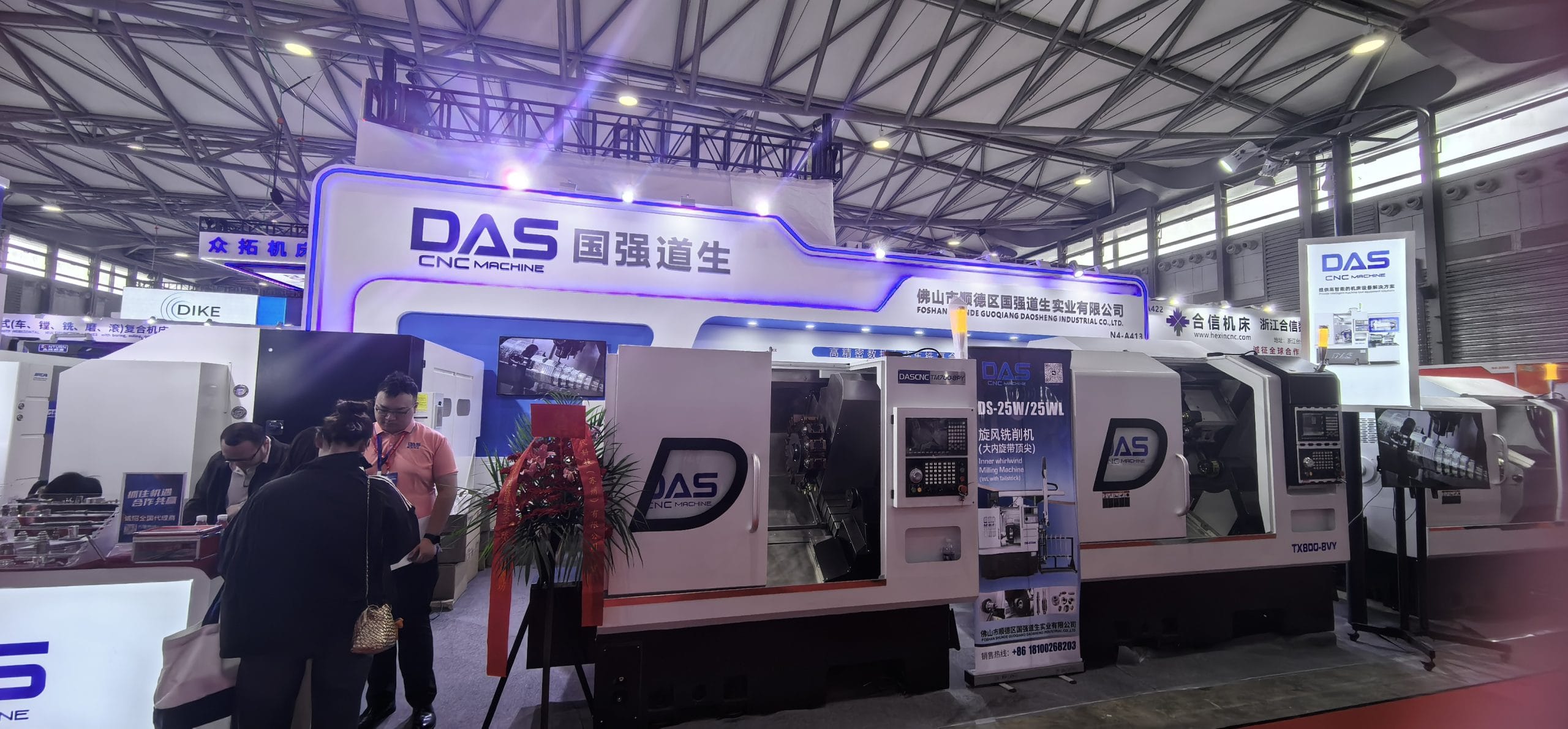
That is why buyers visiting a machine exhibition do not just look for glossy enclosures and bright screens. They look for signs of a machine that can support repeatable production: rigid construction, enclosed chip control, accessible tooling, and a layout that makes sense on a real shop floor. On a DAS CNC MACHINE factory display, the visible lineup suggests exactly that kind of conversation—industrial turning and turning-milling equipment presented as production tools, not just showpieces.
What buyers are really evaluating
When a company considers a high-end lathe, the question is rarely “Can it cut metal?” Almost any machine can do that. The real question is whether it can do it consistently, with the level of control needed for the part mix you plan to run. That includes setup repeatability, chip evacuation, workholding stability, and how much operator intervention the process still demands.
In the booth imagery, the machines appear as enclosed, boxy units with front access doors, control panels, and viewing windows. Those are not decorative details. Enclosures help contain chips and coolant, while the operator interface affects how quickly a team can set up, adjust, and verify jobs. For batch production, those minutes add up quickly.
Quick comparison: what a high-end machine usually gives you
Compared with entry-level turning centers
Higher-end equipment generally aims at better rigidity, more stable long-cycle performance, and smoother integration with tooling and automation. It is usually better suited to parts where secondary finishing hurts margins or where scrap is expensive.
Compared with a general-purpose lathe
A general-purpose lathe can be useful in maintenance or low-volume work, but it is not the same purchasing decision. A production-grade CNC lathe is bought to reduce variation, not merely to spin a part. That matters when you are trying to protect delivery schedules or qualify a new supplier.
Where the application fit becomes obvious
The visible booth materials point toward precision metal component production: shafts, sleeves, threaded parts, and other small-to-medium turned parts used in automotive, hardware, electronics, and broader industrial supply chains. That is the sweet spot where machine stability, cycle efficiency, and consistent part handling can turn into real commercial advantage.
For some buyers, the interest may also extend to combined turning and milling capability. One banner appears to reference turn/milling machine language and another machine label seems to include DS-25W/25WL, while a separate marking looks like TXB00-BVY. Those identifiers are not enough to define the full spec sheet, so they should be treated cautiously. Still, they signal that the booth is showing more than one configuration or model family, which is useful for sourcing teams comparing process options.
Selection criteria that deserve more attention than brochure claims
Engineers usually start with axis count, spindle speed, and tooling capacity. Fair enough. But experienced buyers know that the less glamorous details often decide whether the machine stays productive after month three. Look closely at tool access, chip management, enclosure design, and how the control panel is positioned for daily use. If operators must lean awkwardly or open the machine in an inefficient way, the shop will feel it every shift.
Also consider part family direction. If you are machining mostly repetitive shafts or sleeves, a straightforward turning platform may be enough. If your work mix includes cross-holes, flats, slots, or features that benefit from live tooling, then a turn-mill approach can change the economics. That is where exhibition discussions can be useful: they let you compare machine layouts side by side instead of reading isolated spec sheets in a factory office.
Common mistakes buyers still make
One mistake is buying for peak part geometry instead of the recurring workload. A machine that looks ideal for one difficult component may be overkill for the rest of your production. Another is ignoring the operator experience. A machine can be technically capable and still be a poor shop-floor fit if setup is cumbersome or maintenance access is awkward.
There is also a tendency to over-focus on headline performance while underestimating the value of enclosure integrity and chip control. In high-volume turning, cleanup time and coolant management affect real throughput more than many procurement teams expect. That is not glamorous, but it is where profit leaks happen.
Why exhibitions still matter in machine buying
Seeing a machine at an exhibition is not a substitute for a technical audit, but it is one of the fastest ways to understand design intent. You can compare cabinet build, operator access, display layout, and machine footprint in a way that digital brochures rarely capture. For a DAS CNC MACHINE factory presentation, the advantage is visual: multiple units, positioned together, make it easier to judge lineup breadth and manufacturing seriousness.
For sourcing teams, that matters. A booth with several machines on display suggests the supplier is trying to show a portfolio, not just a single flagship model. That can be helpful if you are trying to standardize a machine base across different component families.
Practical buyer advice before you ask for a quote
Before you request pricing, define the part family, the daily output target, and the features you actually need in production. Ask how the machine is intended to support your specific turning or turn-milling workflow. If the vendor can only talk generally, keep your guard up. A good supplier should be able to discuss how the machine fits batch manufacturing, not just claim it is “high precision.”
And if you are evaluating a booth display like the one from DAS CNC MACHINE, take note of the machine variety. Multiple models displayed side by side can be useful, but only if you know which one matches your process. The wrong machine is still the wrong machine, no matter how polished the enclosure looks.
What to ask next
If you are shortlisting a high-end CNC lathe, ask for the exact model configuration, supported tooling setup, control system details, and the machine’s intended part range. If turn-mill capability matters, confirm that it is real production functionality and not just a general marketing label. That small distinction can save a lot of disappointment later.
For teams comparing suppliers after an exhibition visit, the next step is simple: match the machine’s visible design and claimed application to your actual part drawings. That is where the conversation gets useful, and where a promising machine starts to become a sensible purchase.